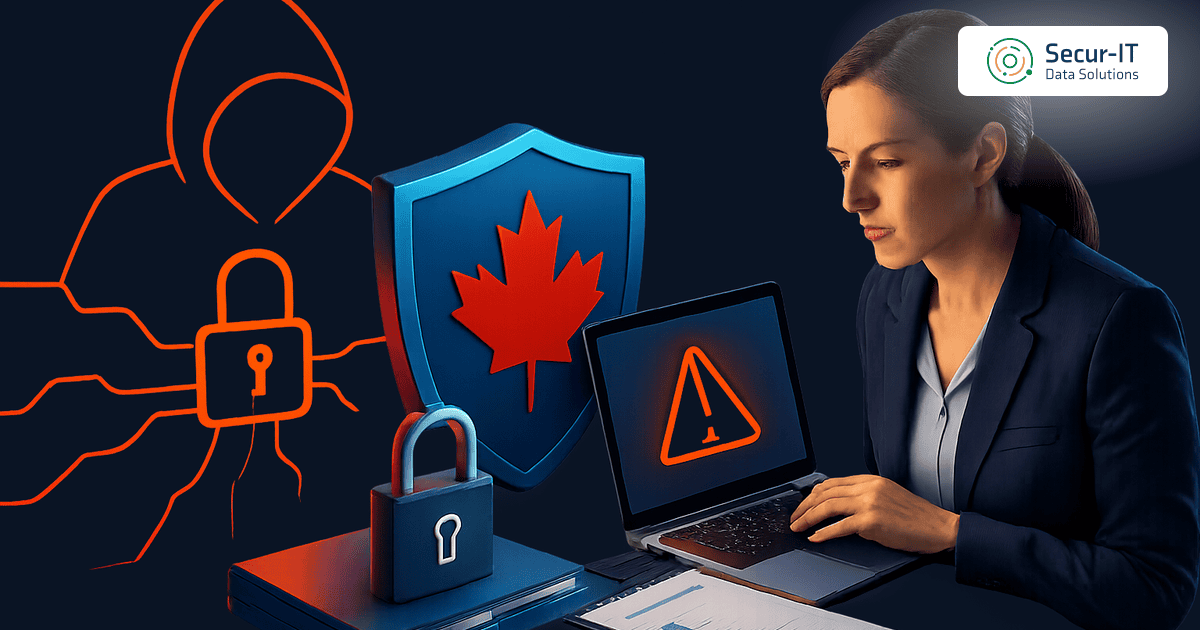
Double extortion ransomware has quietly rewritten the rules of incident response, and the Nova Scotia Power attack shows why every Canadian business needs to pay attention. For years, the standard advice was simple: keep good backups and you can recover. That advice is now dangerously incomplete. When criminals copy your data out the door before they ever encrypt it, a clean backup does nothing to stop them from publishing what they stole.
What Double Extortion Ransomware Actually Means for Your Business
Double extortion ransomware is a two-stage attack. First, the attacker quietly moves through your network and copies sensitive data to their own servers. Only after the theft is complete do they trigger the encryption that locks your systems and demands payment.
The second demand is the twist. Even if you restore everything from backup, the criminals still hold a copy of your data and threaten to leak or sell it unless you pay. That is where the “double” comes from: pay to unlock your files, and pay again to keep your data private.
Nova Scotia Power confirmed a ransomware attack in which customer data was accessed and taken on or around March 19, 2025, according to Nova Scotia Power. The utility stated that no payment was made to the threat actor, citing sanctions law and law enforcement guidance. That decision reflects a hard reality of double extortion ransomware: paying does not guarantee stolen data is ever deleted.
For a Toronto retailer, an Ontario clinic, or a Canadian manufacturer, the lesson is the same. Your backup strategy protects availability, not confidentiality. The moment data leaves your environment, the damage is already done, and recovery becomes a legal and reputational problem rather than a technical one. This is why detection speed, not restore speed, is now the control that matters most.
Why Data Leaves Before Anything Gets Locked
The stolen data in the Nova Scotia Power case was serious. Nova Scotia Power reported that it included names, contact details, dates of birth, account history, driver’s license numbers and Social Insurance Numbers, plus bank account numbers for some customers. That is exactly the kind of information criminals monetize through fraud and identity theft.
Attackers exfiltrate before encrypting because encryption is loud and theft is quiet. Locking systems triggers alarms, halts operations, and forces a response. Copying files, especially in small batches over days or weeks, often blends into normal network traffic and slips past tools that only watch for encryption behavior.
This is where continuous monitoring earns its place. A defense built around detecting unusual outbound data flows, strange login patterns, and access to systems that a given account never touches will catch double extortion ransomware in its quiet stage, before the ransom note appears. Behavioral analytics and around-the-clock human review close the gap that signature-based tools leave open.
SecurityWeek reported on May 26, 2025 that about 280,000 customers were notified, and the utility said generation, transmission and distribution were not disrupted. That operational resilience matters, but the data exposure shows why keeping the lights on is only half the battle. External threat and dark web monitoring can also give early warning when stolen records start appearing for sale, buying an organization precious time to notify and protect the people affected.
How to Catch an Attack Before the Ransom Note
Speed of detection decides whether an intrusion becomes a minor incident or a headline. Use these steps as a practical checklist to shorten the window attackers have to steal your data.
- Monitor outbound traffic continuously. Large or unusual data transfers to unknown destinations are the clearest sign of exfiltration in a double extortion ransomware attack.
- Deploy managed detection and response. A team watching your environment 24/7 can contain a compromised account in minutes rather than days.
- Segment your network. Limit how far an attacker can move once inside, so a single compromised device does not expose your entire data store.
- Enforce multi-factor authentication everywhere. Stolen credentials remain the most common entry point, and MFA blocks most of them.
- Test restores, not just backups. A backup you have never restored is a guess. Verify it works on a schedule.
Our ransomware protection canada approach pairs active containment with quarterly restore testing, because assuming a backup works is how organizations discover it does not at the worst possible moment. The goal is to find the intruder while they are still copying files, not after your data is already listed for sale.
Double Extortion Ransomware and Canadian Compliance Obligations
Double extortion ransomware is no longer an edge case. The Canadian Centre for Cyber Security’s Ransomware Threat Outlook 2025-2027, published January 28, 2026, calls double extortion standard and notes a growing trend of exfiltration-only attacks with no encryption at all. That shift means data theft, not downtime, is becoming the primary threat.
Under PIPEDA, Canadian organizations must report breaches of security safeguards that pose a real risk of significant harm to affected individuals and to the Office of the Privacy Commissioner. When double extortion ransomware exposes names, financial details, and Social Insurance Numbers, that threshold is almost always crossed. Ontario clinics handling health data carry parallel duties under PHIPA.
Frameworks give you a structure to prove due diligence. The NIST Cybersecurity Framework organizes controls around Identify, Protect, Detect, Respond, and Recover, and the Detect function is exactly where most ransomware defenses fall short. CISA’s cybersecurity best practices reinforce the same priorities: monitor, segment, and rehearse your response before you need it.
Documenting your detection and response capabilities is not paperwork for its own sake. It shows regulators, insurers, and customers that you took reasonable steps. If a breach happens anyway, that evidence shapes how the incident is judged.
Common Mistakes to Avoid
- Treating backups as complete ransomware protection. Backups restore availability but do nothing to stop stolen data from being leaked or sold.
- Relying only on signature-based antivirus. Modern attackers use legitimate tools and stolen credentials that traditional scanners never flag.
- Leaving detection to business hours. Attacks often unfold overnight and on weekends, precisely when no one is watching.
- Skipping restore tests. A backup that has never been restored is an untested assumption, not a recovery plan.
- Assuming you are too small to be a target. Automated attacks scan for any exposed weakness, regardless of company size or industry.
Frequently Asked Questions
Q: What is double extortion ransomware and why is it worse than traditional ransomware?
Double extortion ransomware steals your data before encrypting it, then threatens to leak or sell that data unless you pay. It is worse because a clean backup no longer solves the problem: even after you restore your systems, the criminals still hold a copy of your sensitive information.
Q: How long does it take to detect a ransomware attack?
Without continuous monitoring, attackers can operate undetected for weeks while copying data. With 24/7 managed detection and response, unusual activity can be caught and contained in minutes, which is the difference between a contained incident and a public breach.
Q: Backups versus detection, which matters more against ransomware?
Both matter, but they solve different problems. Backups restore your operations, while detection prevents data theft in the first place. Against double extortion, detection speed is the control that limits real harm, because backups cannot un-steal data.
Q: What are my reporting obligations in Canada after a ransomware breach?
Under PIPEDA, you must report breaches that create a real risk of significant harm to affected individuals and to the Privacy Commissioner. Ontario health providers face additional duties under PHIPA, and the Canadian Centre for Cyber Security offers guidance on responding to ransomware incidents.
Q: What is the first step to protect my business from double extortion?
Start by getting visibility into what happens on your network around the clock, since you cannot stop what you cannot see. Our soc as a service canada offering provides that monitoring along with active containment when something is found.
If your current defenses assume backups are enough, it may be time to reconsider. Visit securitdata.ca to learn how continuous detection and Canadian-hosted Microsoft 365 backup close the gap that ransomware exploits.
References
- Nova Scotia Power: Cyber Updates
- SecurityWeek: Nova Scotia Power Confirms Ransomware Attack
- Canadian Centre for Cyber Security: Ransomware Threat Outlook 2025-2027
- CISA, Cybersecurity Best Practices
- NIST Cybersecurity Framework
For securing AI systems as part of a modern security program, SecuritAI is built for exactly that.
Ready to Strengthen Your Cybersecurity?
Secur-IT Data Solutions is a Toronto-based MSSP providing enterprise-grade cybersecurity for Canadian businesses. Whether you need OT security, AI threat protection, penetration testing, or full managed security services, our team is ready to help.
Get a free consultation:
- 📞 Call us: +1 (647) 948-6768
- 📧 Email: info@securitdata.ca
- 🌐 Book a free security assessment →

Krikor Tengerian is the CEO and founder of Secur-IT Data Solutions, a Toronto-based cybersecurity firm focused on helping Canadian organizations secure their infrastructure and critical systems. With over 25 years of experience across cybersecurity and IT infrastructure, he has supported organizations in hardening networks, protecting critical workloads, and aligning security controls with business and regulatory requirements.
Krikor actively shapes the direction and themes of Secur-IT’s educational content, collaborating with AI tools to structure, refine, and expand articles while providing the real-world context, use cases, and review to keep them accurate and practical for readers. He regularly shares insights on OT security, threat detection, incident response, and Canadian cybersecurity compliance to help industrial and commercial organizations better understand and reduce their cyber risk.