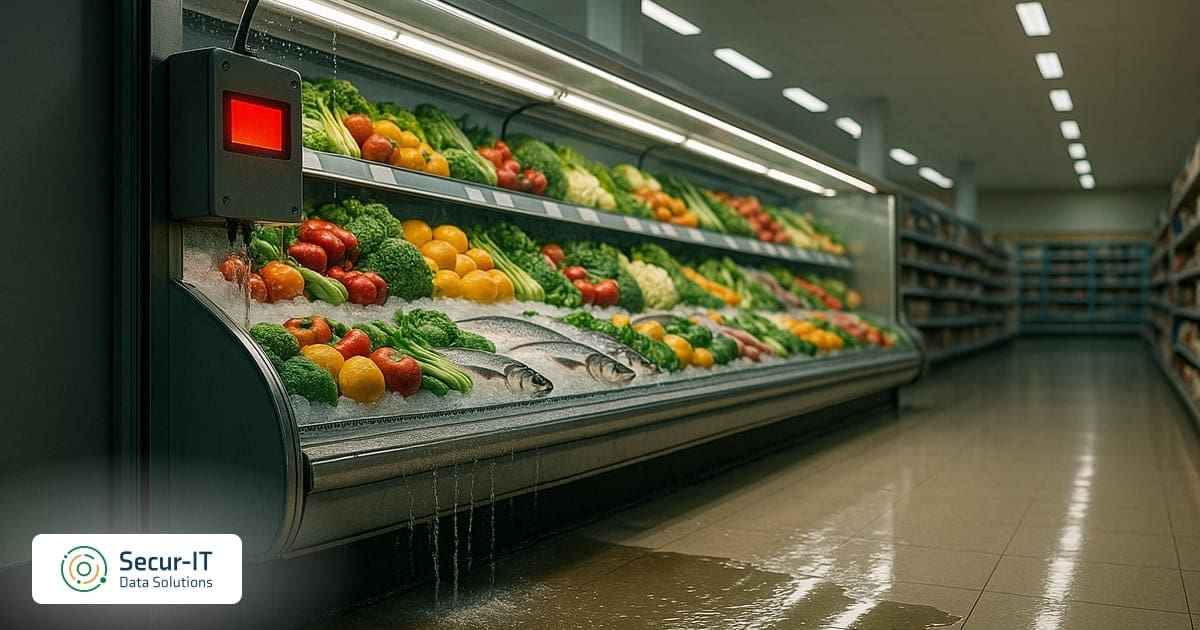
The store is closed, the lights are low, and someone you have never met just switched every freezer into defrost: that is what a refrigeration system cyberattack looked like across France on the night of October 11. By morning, fresh and frozen stock was being thrown away. If you run a grocery store, a cold storage warehouse or a food plant in Canada, the controllers behind your cold rooms may be reachable the same way.
Most operators have never thought of a fridge controller as an IT system, and that is normal. It was installed by a refrigeration contractor, it works, and nobody has touched it in years. That is also why nobody thinks to check it.
What Happened in the French Refrigeration System Cyberattack
Overnight from Sunday, October 11, into Monday, October 12, hackers “managed to remotely trigger the forced defrosting of the refrigeration systems in numerous stores,” according to French broadcaster BFM TV as reported by CBS News and AFP. Paris prosecutors said the refrigeration system cyberattack also sparked fires, and they have opened an investigation.
Store counts moved through the day. Reported figures for Intermarché and Netto run from 200 to at least 300 stores, and fewer than a hundred Système U stores were affected, according to franceinfo and CBS News and AFP. Carrefour said 80 of its supermarkets were attacked while the vast majority of its 6,000 stores were not, and several E.Leclerc stores were hit too.
One detail matters more than the store counts. E.Leclerc said the attack “affected one of its refrigeration equipment suppliers.” In other words, the company that was hit was a supplier, and the stores felt the damage.
Coopérative U’s chief executive, Dominique Schelcher, called the attack unprecedented. In affected stores, whole stocks of fresh and frozen food were destroyed, according to the French retail trade outlet Points de Vente. As of October 12, the reporting names no attacker, and investigators have not said who was behind the refrigeration system cyberattack.
Why Old Controllers Were the Way In
The equipment named in the reporting comes from Danfoss, a Danish manufacturer of refrigeration controls. Danfoss said most affected units were legacy products or current products running outdated firmware, and named its older AK-SM800 and AK-SC355 regulators, which “no longer receive software or security updates,” according to Cooling Post. The current AK-SM800A systems that were hit were running outdated firmware, the company said, and it has long advised customers to update or migrate.
The current product line has had published security problems before. A 2025 advisory from the US Cybersecurity and Infrastructure Security Agency, ICSA-25-140-03, describes an authentication bypass in the AK-SM 8xxA series, fixed in release R4.2, and two further flaws fixed in release 4.3.1. France’s cybersecurity agency says it found a vulnerability in Danfoss software but has not said which one, so treat the advisory as a warning about the category, not as the cause.
Here is the part people get wrong. A refrigeration system cyberattack does not need a clever exploit if the controller sits on the internet with old firmware and a remote login the contractor set up years ago.
The gap is rarely the equipment itself. It is that nobody can say which controllers are reachable, who holds the remote access, and when the firmware was last updated.
How to Protect Your Site: Seven Steps
None of these steps needs new refrigeration equipment on day one. They need someone to own the list before a refrigeration system cyberattack shows you what is missing from it.
- Find every controller that can be reached from the internet: the Canadian Centre for Cyber Security tells operators to take a full inventory of every internet-accessible industrial control device and ask whether each one needs to be reachable at all.
- Take them off the open internet: on October 12, France’s national cyber alert team CERT-FR told operators to disconnect or filter access to these Danfoss controllers, and said exposing a management interface to the internet goes against best practice. CISA’s advisory says the same, with remote access only through a VPN, and the Canadian Centre for Cyber Security adds two-factor authentication on that access.
- Separate cold rooms from the business network: CISA advises placing control system networks behind firewalls, isolated from business networks, so a compromised office laptop cannot reach a freezer.
- Replace or isolate equipment that no longer gets updates: if the manufacturer has stopped issuing security updates for a controller, plan its replacement, and until then keep it on an isolated segment with no inbound access.
- Ask your refrigeration contractor how they connect: who has remote access, from where, with which accounts, and is the password shared across sites? Put the answers in writing and remove access nobody can explain.
- Watch the controllers, not only the computers: alert on setpoint changes and defrost commands outside the normal schedule, at night and on weekends especially.
- Keep an independent temperature alarm: a standalone temperature logger on its own connection tells you a case is warming even if the controller says everything is fine.
If you run other building systems on the same network, such as HVAC or access control, the same logic applies. We covered that wider picture in our guide to building management system security.
Refrigeration System Cyberattack Risk in Canada
This is not a French problem only. In alert AL25-016, published October 29, 2025, the Canadian Centre for Cyber Security described hacktivists abusing internet-accessible industrial control systems in Canada. One incident hit a water facility, another manipulated an automated tank gauge at a Canadian oil and gas company, and a third manipulated temperature and humidity in a grain drying silo on a Canadian farm.
That last example is the closest Canadian match to a refrigeration system cyberattack. A controller that manages temperature for food was changed by someone outside, with potentially unsafe conditions if not caught in time. The agency’s advice is the same as above: inventory, remove direct internet exposure, use a VPN with two-factor authentication, and keep testing and patching what must stay connected.
Canadian grocers and cold storage operators use networked refrigeration controls too. We wrote about devices like these that can be reached from the open internet in our post on exposed ICS devices in Canada. If you found one of yours there, the Canadian Centre for Cyber Security asks that matching activity be reported to it and to the police service for your area.
Where Secur-IT Data Fits
We do not repair or reprogram refrigeration equipment, and we will not replace your refrigeration contractor. That relationship stays where it is. What our team does is the security layer around it, kept independent of the people who install and service the equipment.
- OT security assessment finds which controllers and building systems are reachable, from where, and by whom.
- Network segmentation and managed firewall with 24/7 SOC monitoring keeps cold rooms and building controls away from the office network.
- Data diodes from Advenica let temperature data flow out for monitoring while making it physically impossible to send commands back in.
- Penetration testing and continuous vulnerability management check what has to stay connected, on a schedule.
Being straight about our role here. What stops a refrigeration system cyberattack is unglamorous: an accurate list of controllers, no direct internet exposure, and someone watching. Our job is to do that work with you and keep checking it.
Common Mistakes to Avoid
- Treating refrigeration controllers as appliances instead of networked computers.
- Assuming a refrigeration system cyberattack only happens to large national chains.
- Leaving a contractor’s remote login in place years after the job that needed it ended.
- Using the same remote password across every store.
- Assuming a controller is safe because it still works, even after updates stopped.
- Relying on the controller’s own display to tell you the temperature is fine.
Frequently Asked Questions
Q: What is a refrigeration system cyberattack?
A refrigeration system cyberattack is an intrusion into the controllers that run cold rooms, display cases or freezers, used to change temperatures, force defrost cycles or shut equipment down. In France in October 2026, attackers remotely forced defrost cycles in hundreds of supermarkets, destroying fresh and frozen stock.
Q: How quickly can a site reduce its exposure?
Finding internet-reachable controllers and closing direct access can start in the first days of an assessment. Replacing equipment that no longer receives updates takes longer, so isolate it on its own network segment in the meantime.
Q: Is a VPN enough, or do I need a data diode?
The Canadian Centre for Cyber Security recommends a VPN with two-factor authentication instead of direct internet exposure. A data diode goes further for sites that only need to send data out, because it physically blocks any command from coming back in.
Q: What does Canadian guidance say about securing refrigeration controls?
The clearest Canadian guidance is alert AL25-016 from the Canadian Centre for Cyber Security. It asks operators of internet-accessible control systems to inventory them, remove direct exposure, use a VPN with two-factor authentication, and report matching activity to it and to the police service for your area.
Q: What should I ask my refrigeration contractor?
Ask which of your controllers can be reached remotely, how they connect, which accounts they use and whether passwords are shared across sites. Ask whether any controller has stopped receiving security updates, and get the answers in writing.
If you want to know which of your controllers can be reached from the internet, and who holds the keys, our team at Secur-IT Data can walk you through it.
References
- CBS News and AFP: Hackers turn up the heat in refrigerators at hundreds of supermarkets in France
- CISA: ICS Advisory ICSA-25-140-03, Danfoss AK-SM 8xxA Series
- Canadian Centre for Cyber Security: AL25-016 Internet-accessible industrial control systems abused by hacktivists
- NIST SP 800-82 Rev. 3: Guide to Operational Technology (OT) Security
- CERT-FR (in French): CERTFR-2026-ALE-012, security incident targeting Danfoss AK-SM and AK-SC series
Ready to Strengthen Your Cybersecurity?
Secur-IT Data Solutions is a Toronto-based MSSP providing enterprise-grade cybersecurity for Canadian businesses. Whether you need OT security, AI threat protection, penetration testing, or full managed security services, our team is ready to help.
Talk to our team:
- 📞 Call us: +1 (647) 948-6768
- 📧 Email: info@securitdata.ca
- 🌐 Book a scoping call →

Krikor Tengerian is the CEO and founder of Secur-IT Data Solutions, a Toronto-based cybersecurity firm focused on helping Canadian organizations secure their infrastructure and critical systems. With over 25 years of experience across cybersecurity and IT infrastructure, he has supported organizations in hardening networks, protecting critical workloads, and aligning security controls with business and regulatory requirements.
Krikor actively shapes the direction and themes of Secur-IT’s educational content, collaborating with AI tools to structure, refine, and expand articles while providing the real-world context, use cases, and review to keep them accurate and practical for readers. He regularly shares insights on OT security, threat detection, incident response, and Canadian cybersecurity compliance to help industrial and commercial organizations better understand and reduce their cyber risk.