A PLC cyberattack used to take skill, time and patience. The Canadian Centre for Cyber Security now says attackers are using artificial intelligence to cut both, and that the campaign is aimed at controllers sitting on the open internet.
The warning, on a Canadian Centre for Cyber Security page dated “Date modified: 2026-09-14”, describes an active global campaign in which threat actors target and try to disrupt programmable logic controllers (PLCs) that are exposed to the internet. The most targeted sectors it lists are critical manufacturing, energy, water and wastewater, chemical, food and agriculture, and commercial facilities.
That list covers a large share of Ontario’s plants. This post explains why this PLC cyberattack campaign is happening now, how the attacks work, how controllers end up exposed without anyone noticing, and what to change this month.
Why a PLC Cyberattack Is Easier in 2026
A PLC is a small industrial computer that runs pumps, valves, pressure and temperature. The Canadian Centre for Cyber Security says a threat actor with access to one can disrupt industrial processes, damage equipment and endanger worker and public safety.
What changed is the tooling. In the same warning, the Canadian Centre for Cyber Security says attackers are using AI to generate exploitation scripts that they disguise as legitimate monitoring software, “dramatically reducing the expertise and time needed to develop working attack tools.”
Its cyber threat bulletin on non-state activity targeting Canadian operational technology makes the same point more broadly. It says AI tools that support cyber threat activity are improving fast and let even low sophistication actors run more complex and disruptive attacks against OT systems. The bulletin also notes that these actors are effective because of poor exposure hygiene and insecure remote access.
When the Warnings Came
The timeline matters, because it shows the activity did not stop when it was reported.
- August 19, 2026: the NSA, CISA, FBI, Department of Energy and EPA released joint advisory AA26-231A, Defending Against an Active Threat to Siemens S7 Series PLCs. The Canadian page links it.
- The days after: news outlets, including The Record and Help Net Security, reported the same core detail, that the scripts were AI generated and built to look like legitimate OT monitoring tools.
- September 14, 2026: the Canadian Centre for Cyber Security page carries this modification date. It says partners issued their most recent warnings in August 2026 and that the actors very likely continue to operate despite public reporting.
The Canadian Centre for Cyber Security also says Canada has not had a high impact ICS or OT incident so far. It adds that the threat is increasing and that future incidents will likely be more severe. Last year’s hacktivist alert, covered in our post on exposed ICS devices in Canada, was an earlier sign of the same pattern.
How a PLC Cyberattack Works, Step by Step
The joint advisory gives the clearest account of the method, and the Canadian page matches it. A PLC cyberattack in this campaign follows a short, repeatable path.
- Find the device: attackers use internet scanning services to find exposed PLCs.
- Get in: the Canadian page says they take advantage of weak, default or absent passwords. The advisory describes devices with unconfigured or minimally configured authentication.
- Talk to the controller: the advisory says the actors combine an open source automation library, snap7 and python-snap7, with AI assisted scripting. The resulting tools give read and write access to PLC memory, configuration data and ladder logic over the S7comm protocol.
- Hide in plain sight: the scripts are masqueraded as legitimate monitoring tools to evade detection by security teams.
- Cause effects: the Canadian Centre for Cyber Security says that after access, attackers have changed device settings, disabled alarms and locked operators out, forcing facilities into manual operations.
The advisory names Siemens S7-200, S7-300, S7-400, S7-1200 and S7-1500 controllers. It also states that ongoing PLC targeting is broader than Siemens. So a PLC cyberattack is a risk for any brand of controller that can be reached from the internet with a weak password.
The agencies assess this PLC cyberattack activity as likely persistent reconnaissance. In plain terms, the attackers are reading and testing now so they can cause disruption later.
How Plants Get Exposed Without Knowing It
This is the part that should worry plant managers most. The Canadian Centre for Cyber Security says many PLCs are exposed to the internet unintentionally and without the knowledge of the organizations that own them.
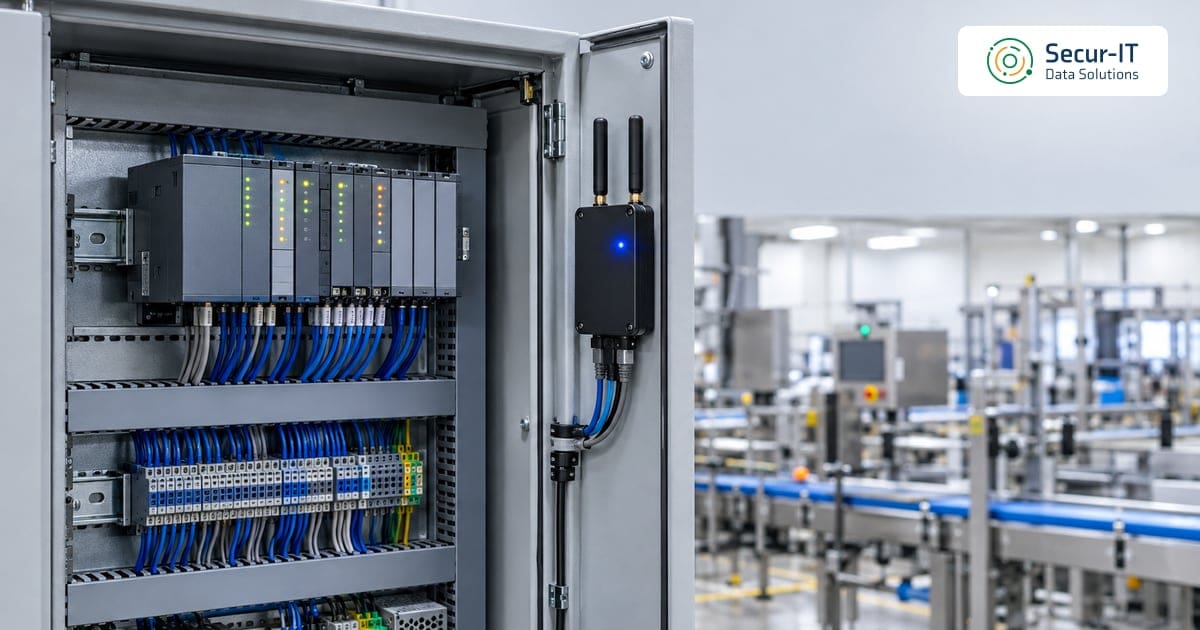
The warning names two common paths. A control system can be isolated from the corporate IT network and still be reachable from the internet, because “a cellular modem or a vendor remote access connection installed during commissioning or maintenance may provide access.”
Those connections, it says, are often undocumented, kept after they are no longer needed, and missed by routine attack surface scans. CISA’s Internet Exposure Reduction Guidance reports that malicious activity against more than 100 water and wastewater entities in July 2026 commonly came through PLCs connected directly to a cellular modem.
The usual exposure paths on a plant floor look like this:
- A cellular modem in the control cabinet added so an integrator could dial in during startup.
- A vendor remote access account set up for warranty support and never removed.
- A PLC web server or programming port left open on a public IP address.
- A default password that was never changed because the line had to start on time.
A PLC cyberattack does not need to break through your corporate firewall if one of these paths goes around it.
The Integrator Question: Who Owns PLC Cyberattack Risk?
The Canadian Centre for Cyber Security says the risk of unknown exposure is greatest for organizations that rely on system integrators or third party service providers with remote access for maintenance, monitoring or support. It adds that even mature security programs should check their external connections with those partners.
It is also direct about why gaps appear: an unclear division of roles between an organization and its service providers often leaves critical systems unprotected. Its advice is to consider “including maintenance, security responsibilities, and liability in service agreements.”
For an Ontario manufacturer or utility, that turns into a short list of contract questions:
- Who maintains each remote connection, and who removes it when the job ends?
- Who changes default passwords at commissioning, and who records that it was done?
- Who patches PLC firmware and engineering software, and on what schedule?
- Who is liable if an integrator’s connection is the way in?
CISA’s exposure guidance adds a practical step: ask for the external IP addresses of anything the integrator set up, plus updates if those addresses change. The joint advisory says organizations that rely on integrators should share the advisory with them and ask them to apply its mitigations.
How to Avoid a PLC Cyberattack: Eight Steps
The Canadian Centre for Cyber Security bulletin calls removal of OT systems from direct internet exposure the most effective defense, and says other controls are insufficient on their own if the systems stay reachable. Start there.
- Scan the address ranges you own and look for exposed PLCs, HMIs and remote access services, as the Canadian page advises.
- Walk every control cabinet and list each cellular modem, router and remote access box, with the person or company that installed it.
- Disconnect PLCs from the internet. CISA’s Primary Mitigations to Reduce Cyber Threats to Operational Technology puts this first.
- Route necessary remote access through a gateway or VPN, never directly to a PLC or HMI, with unique accounts and phishing resistant multi factor authentication, as CISA’s exposure guidance recommends.
- Change default passwords and turn on PLC password protection. For Siemens S7 controllers, the advisory also says to block TCP port 102 at the perimeter and set protection levels.
- Watch controller traffic. The advisory says to alert on write operations outside change windows and on connections from computers that are not approved engineering workstations.
- Keep a known clean backup of each PLC program so a lockout does not become a long outage. CISA’s July 30, 2026 alert to water utilities gives the same advice for operators locked out by a changed password.
- Practice manual operation. The Canadian Centre for Cyber Security’s guidance on protecting operational technology says to test systems in manual mode and have an incident response plan ready.
None of these steps to prevent a PLC cyberattack needs new production equipment. Most need a list, an owner and a few hours with your integrator.
Where Secur-IT Data Fits
Our OT security services focus on the networks and connections around your PLCs, SCADA, HMIs and engineering workstations, working alongside your plant and engineering teams rather than rewriting process logic. The parts that match this PLC cyberattack campaign:
- OT visibility and risk assessment: OT asset and traffic discovery, and mapping of network zones and data flows, including remote access and vendor connectivity, to find the high risk paths.
- Network segmentation and policy design: zoning between OT and IT, and hardening of remote access and vendor connections.
- Secure IT and OT integration: one way data flows with data diodes, so plant data can leave OT without opening a path back in.
- Incident readiness and response support: OT aware monitoring use cases and playbooks for escalation and containment.
Most sites begin with our OT security starter engagement, which pairs an asset and flow visibility assessment with a design to protect one high risk data flow. On site work is quoted after a short scoping call.
Frequently Asked Questions
Q: What is the 2026 PLC cyberattack campaign the Canadian Centre for Cyber Security warned about?
It is an active global campaign against internet exposed programmable logic controllers. The Canadian Centre for Cyber Security says attackers find exposed devices with scanning services, use weak, default or absent passwords to get in, and use AI to build exploitation scripts disguised as legitimate monitoring software.
Q: Which sectors are most targeted?
The warning lists critical manufacturing, energy, water and wastewater, chemical, food and agriculture, and commercial facilities. It says organizations of every size are being targeted.
Q: Our control network is separate from IT. Are we safe from a PLC cyberattack?
Not necessarily. The Canadian Centre for Cyber Security says a control system can be isolated from IT and still be reachable through a cellular modem or vendor remote access connection installed during commissioning or maintenance.
Q: Is this only a Siemens problem?
No. The US joint advisory focuses on Siemens S7 controllers but states that ongoing PLC targeting is broader than Siemens, and that all PLC owners should apply the relevant mitigations.
Q: Who do we report an incident to in Canada?
The Canadian Centre for Cyber Security’s guidance on protecting operational technology says to report the incident to the Canadian Centre for Cyber Security and the RCMP, depending on its nature and severity.
If you want to know which of your controllers can be reached from the internet today, and which integrator connection to close first, our team at Secur-IT Data can walk you through it.
References
- Canadian Centre for Cyber Security: Cyber threat actors use artificial intelligence in an active global campaign to disrupt internet-exposed programmable logic controllers
- CISA, NSA, FBI, DOE and EPA: Defending Against an Active Threat to Siemens S7 Series PLCs (AA26-231A)
- Canadian Centre for Cyber Security: Cyber threat bulletin, non-state activity targeting Canadian operational technology
- CISA: Internet Exposure Reduction Guidance
- CISA: Primary Mitigations to Reduce Cyber Threats to Operational Technology
Ready to Strengthen Your Cybersecurity?
Secur-IT Data Solutions is a Toronto-based MSSP providing enterprise-grade cybersecurity for Canadian businesses. Whether you need OT security, AI threat protection, penetration testing, or full managed security services, our team is ready to help.
Talk to our team:
- 📞 Call us: +1 (647) 948-6768
- 📧 Email: info@securitdata.ca
- 🌐 Book a scoping call →

Krikor Tengerian is the CEO and founder of Secur-IT Data Solutions, a Toronto-based cybersecurity firm focused on helping Canadian organizations secure their infrastructure and critical systems. With over 25 years of experience across cybersecurity and IT infrastructure, he has supported organizations in hardening networks, protecting critical workloads, and aligning security controls with business and regulatory requirements.
Krikor actively shapes the direction and themes of Secur-IT’s educational content, collaborating with AI tools to structure, refine, and expand articles while providing the real-world context, use cases, and review to keep them accurate and practical for readers. He regularly shares insights on OT security, threat detection, incident response, and Canadian cybersecurity compliance to help industrial and commercial organizations better understand and reduce their cyber risk.