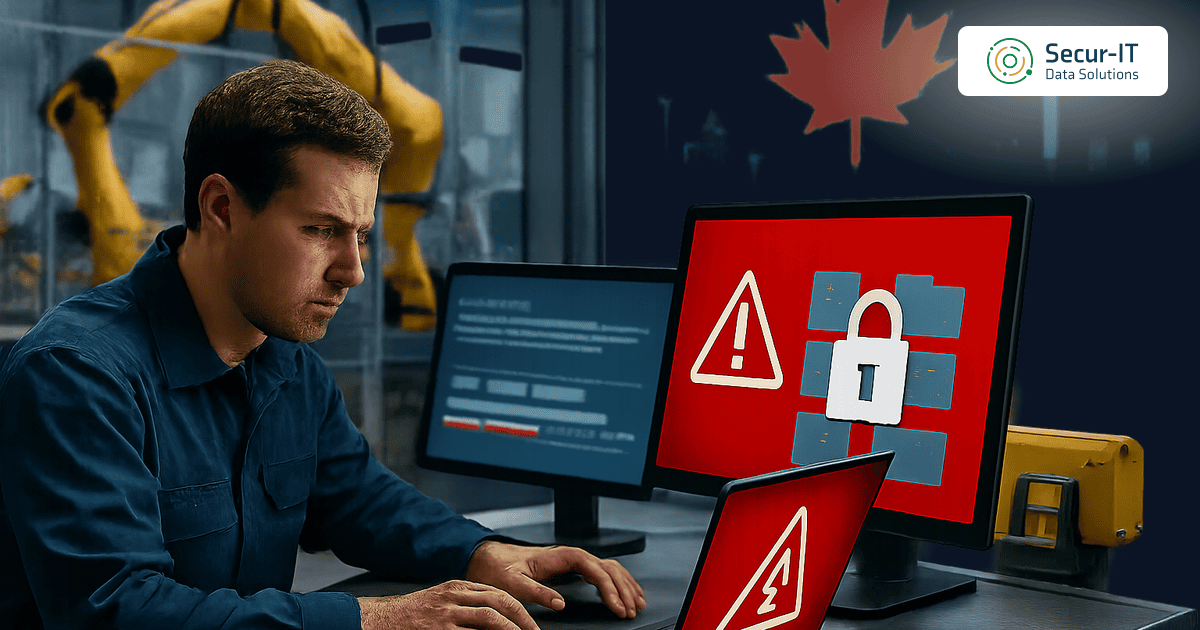
Manufacturing ransomware Canada is no longer a rare headline event, and any plant owner in Ontario knows what a stopped line costs per hour. When the office network goes dark, the question that matters is whether your shop floor can keep producing. That depends on choices you make long before the attack. This article is written for Canadian manufacturers and auto parts suppliers who need to plan for weeks of workarounds, not days.
Why Manufacturing Ransomware Canada Keeps Growing
Manufacturing ransomware Canada attracts criminals for a simple reason: downtime is expensive, and that makes operators more likely to pay. The Canadian Centre for Cyber Security’s Ransomware Threat Outlook 2025-2027 says ransomware actors targeting Canada are almost certainly opportunistic and financially motivated. They are not hunting your brand specifically. They are scanning for the easiest way in.
That same report from the Canadian Centre for Cyber Security lists how they get that access: unpatched software, stolen credentials, phishing, and remote desktop. None of those are exotic. They are the everyday gaps a busy plant leaves open while chasing production targets.
Here is the part most plants underestimate. Even when an attack hits the IT side, the real pain is often operational. Montreal manufacturer Imaflex was hit by a cyber attack on February 21, 2025 that disrupted manufacturing, shipping, and back-office functions, according to Imaflex. The company kept operating with workarounds and announced on March 27, 2025 that systems were fully restored.
Read those dates again. That is more than a month of running on manual processes, paper, and phone calls. Manufacturing ransomware Canada incidents rarely resolve in a weekend. If your recovery plan assumes a 48-hour outage, it assumes wrong. Plan for weeks, and the shorter outage becomes a pleasant surprise instead of a crisis.
Separating the Plant Floor From the Office Network
The single most valuable defense against manufacturing ransomware Canada is keeping operational technology (OT) and information technology (IT) on separate networks. If a phishing email takes down the office, your PLCs, HMIs, and production controllers should not even be reachable. One flat network means one breach stops everything.
Most Canadian plants grew their networks organically. A controller got patched in through the office switch because it was convenient. A vendor opened a remote desktop connection and nobody closed it. Over years, the line between office and floor disappears, and attackers love that.
Real segmentation is not a single firewall rule. It means defined zones and conduits, controlled traffic between them, and no direct path from a receptionist’s laptop to a welding cell. Our industrial cybersecurity ontario practice starts with an OT security assessment that maps what actually talks to what, which is almost never what the diagram on the wall claims.
A few practical layers that hold up under pressure:
- Physical or logical separation between the enterprise network and the production network
- A managed Fortinet FortiGate firewall enforcing which systems may cross between zones
- Tight control over vendor remote access, with sessions that expire and get logged
- Backups for both workstations and servers, with restore testing so you know they work
Segmentation is the difference between losing your email and losing your ability to ship product. Manufacturing ransomware Canada becomes survivable when the attack can only reach one half of your business.
How to Build a Workaround-Ready Plan
You cannot wait for the incident to figure out how to run manually. Build the plan now, while the line is calm. Here is a practical order of operations.
- Map your critical production processes and ask: can this run without the network? If not, document the manual fallback.
- Print and store offline the work instructions, part specs, and shipping templates your team would need for two weeks.
- Identify which systems are truly essential and which can stay dark during recovery.
- Set up workstation and server backup with restore testing, so you are rebuilding from known-good copies, not hoping.
- Pre-arrange 24/7 managed detection and response so an intrusion gets caught early, before it reaches the line.
Imaflex kept operating with workarounds during its outage, according to Imaflex. That only works if the workarounds exist before the screens go blank.
Run a tabletop exercise where you pretend the office network is gone for ten business days. Who approves shipments? How do you cost a job without the ERP? Teams that rehearse this recover faster. Manufacturing ransomware Canada punishes improvisation and rewards preparation.
Compliance and Standards for Manufacturing Ransomware Canada
Manufacturing ransomware Canada sits inside a real regulatory picture, and ignoring it adds legal risk on top of operational loss. Under PIPEDA, if an attack compromises personal information and creates a real risk of significant harm, you have breach notification obligations. Employee records and customer contact data both count.
The Canadian Centre for Cyber Security publishes guidance that maps cleanly onto plant environments, and the NIST Cybersecurity Framework gives you a structure to organize controls around identify, protect, detect, respond, and recover. For the OT side specifically, the IEC 62443 series is the standard that matters, covering zones, conduits, and security levels for industrial systems.
If you supply the automotive sector, your customers increasingly expect evidence of these controls before they trust you with their production schedule. Meeting iec 62443 compliance canada expectations is becoming a condition of doing business, not a nice-to-have. Manufacturing ransomware Canada preparedness and contract eligibility are now the same conversation.
Standards are not paperwork for its own sake. They are a checklist written in the blood of other people’s outages, and they tell you exactly where plants tend to fail.
Common Mistakes to Avoid
These are the patterns that turn a contained incident into a month-long shutdown:
- One flat network. If office and plant share a subnet, one phishing click can stop production. Segment first.
- Untested backups. A backup you have never restored is a guess. Restore testing turns it into a plan.
- Forgotten remote access. Old vendor remote desktop sessions and default credentials are exactly what the Canadian Centre for Cyber Security names as entry points.
- Assuming a short outage. Recovery can run for weeks. Plan manual operations accordingly.
- No monitoring. Without detection, attackers move through your network for days unnoticed. Catching them early limits the blast radius.
Frequently Asked Questions
Q: What makes manufacturing ransomware Canada different from other industries?
Manufacturing ransomware Canada targets businesses where downtime directly stops revenue, which pressures operators to pay quickly. Plants also tend to run older operational technology that is hard to patch, giving attackers more openings than a typical office environment.
Q: How long does it take to recover from a manufacturing ransomware attack?
Recovery often runs for weeks, not days. One Canadian manufacturer, Imaflex, was hit on February 21, 2025 and announced full restoration on March 27, 2025, according to Imaflex, operating with workarounds in between. Plan your contingency for at least two weeks of manual operation.
Q: What is the difference between IT security and OT security for a plant?
IT security protects your office systems, email, and business data, while OT security protects the controllers, HMIs, and machines on your production floor. The two need separate networks and separate controls so an attack on one cannot spread to the other.
Q: What are my legal obligations after a ransomware attack in Canada?
Under PIPEDA, if the breach involves personal information and poses a real risk of significant harm, you must notify affected individuals and the Privacy Commissioner. You should also consult the Canadian Centre for Cyber Security guidance on reporting and response.
Q: Where should a Canadian manufacturer start to improve defenses?
Start with an OT security assessment to map what connects to what, then prioritize network segmentation and tested backups. Add 24/7 managed detection and response so intrusions get caught before they reach the line.
If you run a plant in Ontario and want to pressure-test your segmentation and recovery plan, the team at securitdata.ca can help you start with an OT security assessment.
References
- Imaflex: Resumes Normal Operations Following Cybersecurity Incident
- Canadian Centre for Cyber Security: Ransomware Threat Outlook 2025-2027
- CISA, Cybersecurity Best Practices
- NIST Cybersecurity Framework
- CSE National Cyber Threat Assessment
For securing AI systems as part of a modern security program, SecuritAI is built for exactly that.
Ready to Strengthen Your Cybersecurity?
Secur-IT Data Solutions is a Toronto-based MSSP providing enterprise-grade cybersecurity for Canadian businesses. Whether you need OT security, AI threat protection, penetration testing, or full managed security services, our team is ready to help.
Get a free consultation:
- 📞 Call us: +1 (647) 948-6768
- 📧 Email: info@securitdata.ca
- 🌐 Book a free security assessment →

Krikor Tengerian is the CEO and founder of Secur-IT Data Solutions, a Toronto-based cybersecurity firm focused on helping Canadian organizations secure their infrastructure and critical systems. With over 25 years of experience across cybersecurity and IT infrastructure, he has supported organizations in hardening networks, protecting critical workloads, and aligning security controls with business and regulatory requirements.
Krikor actively shapes the direction and themes of Secur-IT’s educational content, collaborating with AI tools to structure, refine, and expand articles while providing the real-world context, use cases, and review to keep them accurate and practical for readers. He regularly shares insights on OT security, threat detection, incident response, and Canadian cybersecurity compliance to help industrial and commercial organizations better understand and reduce their cyber risk.