
What Is a Data Diode?
The One-Way Door That Keeps OT Networks Safe
A true data diode is a hardware device that physically enforces one-way data transfer — making it impossible, at the physics level, for any attacker, malware, or misconfiguration to send data back into your operational technology network.
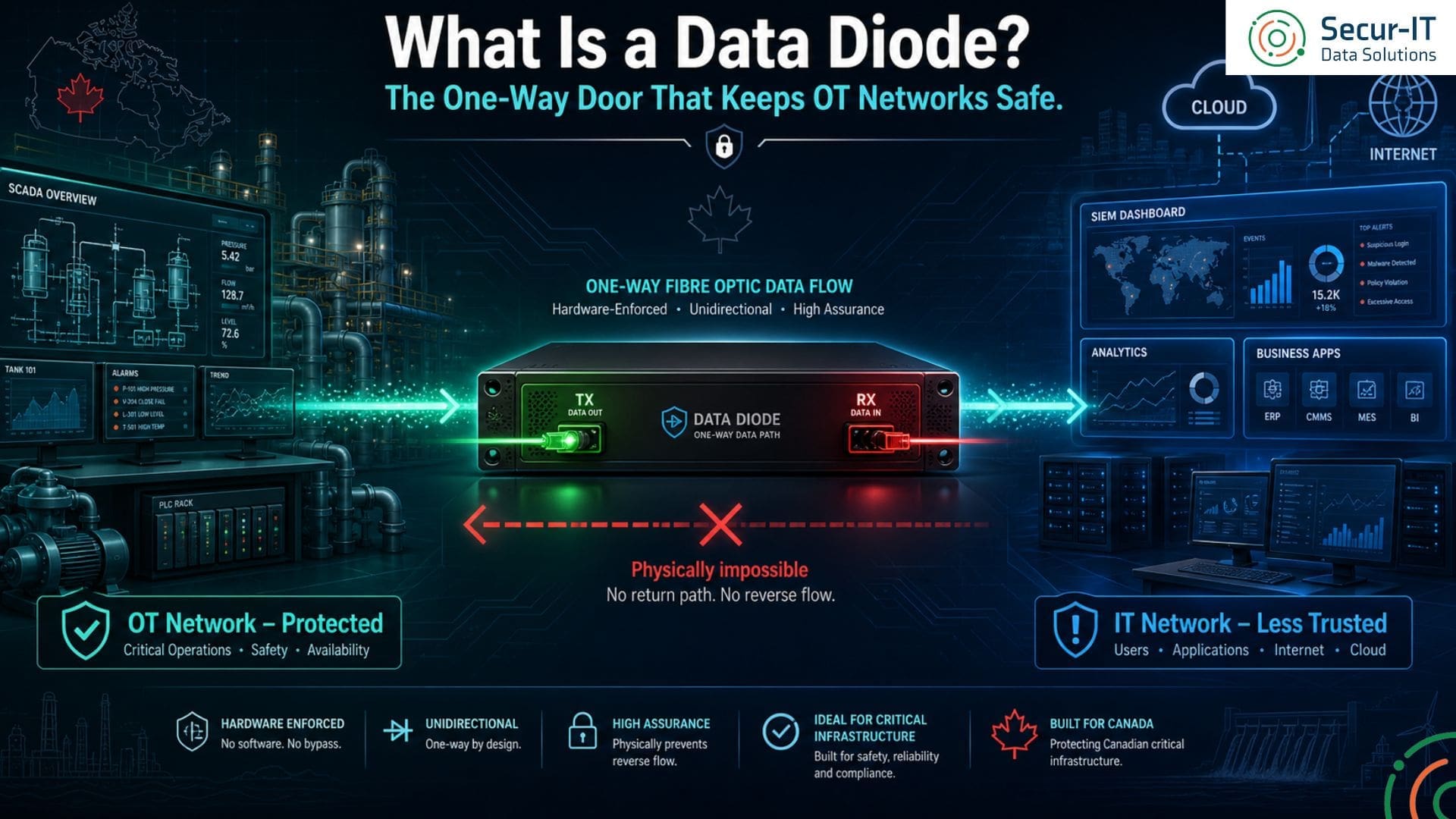
How a hardware data diode enforces one-way data flow — OT network (protected) to IT network (less trusted). No return path exists. Graphic: Secur-IT Data Solutions.
A data diode is a hardware cybersecurity device that enforces strictly one-way data transfer between two networks — for example, from an OT network to an IT network — using optical technology (a fibre-optic transmitter on one side, a receiver with no laser on the other). Because there is no physical path for data to return, no remote attacker, ransomware, or software vulnerability can ever reach the protected side. True data diodes are certified for use in defence, critical infrastructure, and high-assurance industrial environments worldwide.
If you run a manufacturing facility, energy plant, water treatment operation, or any organization that relies on operational technology (OT) — SCADA systems, PLCs, DCS, or industrial control systems — you face a problem that a firewall was never designed to solve.
Firewalls are software. They can be misconfigured. They can be compromised. They can be bypassed with a well-crafted exploit. For a power grid or a pharmaceutical production line, "might be bypassed" is not an acceptable risk level.
This is why the world's most secure industrial environments — nuclear facilities, defence installations, oil and gas operations, and increasingly Canadian manufacturers and critical infrastructure operators — use data diodes.
In this guide, we explain what a data diode actually is, how it works physically, what it protects against, and why several vendors selling "data diode-like" products are not offering the same level of assurance as a true hardware data diode.
What Is a Data Diode — And Why Does "Hardware" Matter?
The term "data diode" comes from the electrical diode — a component that allows current to flow in only one direction. A cybersecurity data diode applies this same principle to network data: it allows data to flow from a protected network (your OT environment) to an external network (your IT systems or a monitoring platform), but makes any data flow in the reverse direction physically impossible.
The critical word is physically. Unlike a firewall — which uses software rules to block traffic and can theoretically be bypassed — a true hardware data diode enforces one-way flow through its physical construction. The most common implementation uses fibre optics:
- The transmit (TX) side contains a fibre-optic laser transmitter — it can only send light signals.
- The receive (RX) side contains an optical receiver — it can only receive light signals. There is no laser on the receive side.
Without a laser on the receiving side, there is no physical mechanism to send light back in the opposite direction. No software update, no hacker, no misconfiguration can change the laws of physics. Data literally cannot travel back through the device — not because a rule says so, but because there is no hardware path for it to take.
Figure 1: A hardware data diode uses a fibre-optic transmitter (TX) on the OT side and an optical receiver with no laser (RX) on the IT side. Without a laser on the RX module, no data can physically travel back into the OT network — regardless of software, configuration, or attacker capability. Advenica DD1000i implements this principle in a certified 1U rack appliance.
How a Data Diode Protects Your OT Environment
Operational technology environments have unique security requirements that make conventional cybersecurity tools inadequate:
- You cannot easily patch OT systems. Many PLCs and SCADA components run legacy firmware that cannot be updated without risking production stability or voiding vendor warranties.
- Downtime is catastrophically expensive. For a manufacturer, every hour offline can cost tens or hundreds of thousands of dollars. A ransomware attack on an OT network is not just a cybersecurity incident — it is a business emergency.
- Remote access is a primary attack vector. Once an attacker gains access to your IT network, they attempt to move laterally into the connected OT environment. This is called IT/OT convergence exploitation.
A data diode solves the core problem: it allows your OT systems to send operational data — process logs, historian exports, sensor readings, SCADA telemetry — to your IT systems for monitoring and business intelligence, without opening any return path that an attacker could use to reach the OT environment.
Common use cases for data diodes in OT environments
- Log and historian export: Send process data from SCADA historians to enterprise analytics systems — one way, no attack surface back in.
- SOC monitoring: Export OT network logs to your Security Operations Centre (SOC) without the SOC connection becoming an attack path into the control network.
- OPC-UA data streaming: Stream real-time process data from ICS networks to IT networks for monitoring and optimization.
- MQTT/sensor data aggregation: Aggregate IoT and industrial sensor data into centralized cloud or edge platforms.
- Compliance reporting: Export audit logs and compliance data to regulatory reporting systems without exposing the OT network.
Why Advenica Builds True Hardware Data Diodes
Not all devices sold as "data diodes" offer the same level of assurance. Advenica, founded in 1993 and headquartered in Malmö, Sweden, builds data diodes that have been trusted by Swedish national security, European defence agencies, and critical infrastructure operators for over three decades.
Secur-IT Data Solutions is an authorized Advenica partner in Canada — one of very few firms in the country qualified to design, deploy, and support Advenica data diode solutions for Canadian industrial and government clients.
Advenica — Hardware-Enforced Data Diodes for Critical Infrastructure
Founded in 1993. Trusted by Swedish national security and European defence agencies. Certified to the highest EU and national security standards. Advenica's DD1000i and DD500E data diodes use optical separation and integrated proxy software to enforce one-way data flow for industrial, defence, and infrastructure environments — with zero return path at the hardware level.
Explore Advenica Data Diodes →Advenica's flagship products: DD1000i and DD500E
DD1000i (Data Diode 1000i): Advenica's best-selling data diode — a compact 1U 19-inch rack appliance with integrated proxy servers. It supports 1Gbps interfaces, built-in heartbeat monitoring, SNMP/Syslog management, and a growing library of protocol-specific services (file transfer, log export, OPC-UA, MQTT). The one-way data flow is enforced by a separate hardware component that is physically isolated from all proxy software — ensuring that no software vulnerability can create a reverse channel.
DD500E (Data Diode 500E): Designed specifically for industrial environments, the DD500E provides the same optical hardware enforcement in a form factor suited to factory floors and industrial control rooms. It meets demanding ICS deployment requirements while maintaining the same uncompromising hardware separation.
DDSFX-10G: Advenica's unique SFP-based data diode — the only data diode in the world delivered as an SFP module, enabling integration directly into existing switches and network infrastructure at 10Gbps speeds. This makes it exceptionally easy to retrofit into existing industrial network architectures without major infrastructure changes.
Not All "Data Diodes" Are Created Equal: The Waterfall Security Question
When buyers research data diodes, they frequently encounter Waterfall Security Solutions, an Israeli company that markets its products as "Unidirectional Security Gateways" — and sometimes positions them as data diodes. It is important to understand the technical difference, because the distinction has real security implications.
What Waterfall Security actually sells
Waterfall's product — the Unidirectional Security Gateway (USG) — is, by their own description, a combination of hardware and software. The hardware component enforces one-way data transfer at the physical layer (similar to a data diode), but the software layer — which handles protocol replication, server emulation, and application integration — runs on top of that hardware and is responsible for a significant portion of the product's security behaviour.
Waterfall itself explicitly distinguishes between traditional data diodes and their Unidirectional Gateways in their own documentation. They describe classic data diodes as constrained to connectionless protocols (broadcast UDP/IP) and argue that their software layer is what makes the product practical for modern IT/OT integration. This is accurate — but it is also an acknowledgement that their product is not a pure hardware data diode.
The security distinction that matters
The core difference comes down to this question: what is enforcing the one-way guarantee?
| Security Property | True Hardware Data Diode (Advenica) | Unidirectional Gateway (Waterfall) |
|---|---|---|
| One-way enforcement mechanism | ✓ Physical hardware only — optical TX/RX with no return laser | ◑ Hardware component + software layer working together |
| Bypassable via software exploit? | ✓ No — physics cannot be exploited by software | ◑ The hardware itself cannot be bypassed, but software layer introduces attack surface |
| Bypassable via misconfiguration? | ✓ No — hardware state is fixed at manufacture | ◑ Software configuration errors could theoretically affect behaviour |
| Protocol support / ease of integration | ◑ Requires proxy software (Advenica Data Diode Engine) — growing library of services | ✓ Broader out-of-the-box protocol and application support |
| Government / defence certification | ✓ EU/national approval, N3 assurance, Swedish national security use | ◑ Deployed in regulated sectors; ANSSI-recognized; fewer formal certifications at highest assurance level |
| Suitable for highest-classification environments | ✓ Yes — defence, intelligence, nuclear, government | ◑ Best suited for industrial/commercial critical infrastructure |
| Deployment complexity | ◑ Requires integration planning; Secur-IT provides deployment support in Canada | ✓ More out-of-the-box integrations available |
| Covert channel elimination | ✓ Special engineering attention given to eliminating covert reverse channels | ◑ Hardware enforces direction; software layer is a potential (though unlikely) covert channel consideration |
Which is right for your organization?
The honest answer depends on your security requirements and operating environment:
- Choose a true hardware data diode (Advenica) if your environment handles defence information, government-classified data, nuclear operations, safety-critical infrastructure, or any scenario where the absolute certainty of one-way enforcement is required — where even a theoretical software risk is unacceptable. Advenica's products are certified to the highest EU and national assurance levels specifically for these use cases.
- Consider a Unidirectional Security Gateway (Waterfall) if your primary driver is IT/OT data integration at scale, you need broad out-of-the-box protocol support, and your threat model does not require the absolute hardware-only assurance of a certified data diode. Waterfall has strong deployments in power, oil and gas, and water treatment where the combination of hardware and software is appropriate.
The OT Security Landscape in Canada: Why Data Diodes Matter Now
Canadian industrial operators are at a critical inflection point. Several converging forces are making OT security — and high-assurance solutions like data diodes — not just advisable but essential:
1. Bill C-8 — Canada's Critical Cyber Systems Protection Act
Bill C-8 will require designated operators of critical infrastructure — including those in finance, telecommunications, energy, transportation, and federally regulated pipelines and nuclear facilities — to establish formal cybersecurity programs, protect critical cyber systems (explicitly including OT), and report incidents to the Government of Canada. While the exact regulatory requirements are still being finalized, data diodes align directly with the high-assurance OT isolation controls that regulators will expect designated operators to implement.
2. The IT/OT convergence attack vector
Attackers have learned that OT environments — historically isolated from IT networks — are now increasingly connected to enable remote monitoring, predictive maintenance, and enterprise data integration. This connectivity, without proper segmentation, creates a direct path from the internet to production systems. The 2021 Colonial Pipeline ransomware attack — which shut down fuel supply to the US East Coast — began in IT systems and crossed into OT through exactly this kind of insufficiently segmented connection.
3. Cyber insurance requirements
Canadian cyber insurance providers are tightening their requirements for coverage. OT-connected organizations are increasingly being asked to demonstrate network segmentation controls between IT and OT environments as a condition of coverage. A data diode provides documented, certifiable proof of one-way isolation that satisfies underwriter requirements for the highest assurance tier.
4. Manufacturing is the most attacked sector
According to Check Point Research's 2025 Global Threat Intelligence Report, manufacturing surpassed healthcare to become the most attacked industry sector globally. Canadian manufacturers — particularly in the automotive supply chain, food processing, and aerospace sectors concentrated in the GTA — are attractive targets precisely because production downtime creates immediate leverage for ransomware extortion.
How Secur-IT Deploys Advenica Data Diodes for Canadian Organizations
As the authorized Advenica partner in Canada, Secur-IT Data Solutions provides the full deployment lifecycle for data diode projects in Canadian industrial and government-adjacent environments:
- OT Security Assessment: We begin with a free assessment of your current IT/OT architecture, identifying the data flows that need to be protected and the appropriate data diode integration points.
- Architecture design: We design the network segmentation architecture — determining which Advenica product is right for your environment (DD1000i, DD500E, or DDSFX-10G), and specifying the proxy services required for your specific use cases (SCADA historian export, log shipping, OPC-UA, MQTT).
- Deployment without production disruption: Data diode deployment follows an OT-first methodology — we schedule all installation activities during planned maintenance windows and use passive monitoring during the assessment phase to eliminate risk to live production environments.
- Ongoing SOC integration: Once deployed, your OT network feeds one-way log and telemetry data into Secur-IT's 24/7 Security Operations Centre — giving your team full visibility into OT threats without creating any return path into the OT network.
- Compliance documentation: We provide documentation of the data diode deployment for cyber insurance, Bill C-8 readiness, and any other regulatory reporting requirements.
Ready to protect your OT environment?
Book a free OT security assessment with Secur-IT Data Solutions — Toronto's authorized Advenica data diode partner in Canada. We'll assess your current IT/OT architecture and recommend the right solution for your environment.
Book Free OT Security AssessmentNo commitment. No disruption to production. Results within 5 business days.
References
- Advenica. Data Diode DD1000i — Product Page. Advenica AB, 2026. https://advenica.com/products-and-solutions/data-diodes/data-diode-dd1000i/
- Advenica. Data Diode DD500E — Industrial Data Diode. Advenica AB, 2026. https://advenica.com/products-and-solutions/data-diodes/
- Advenica. Use Case: Protecting Information in Critical Infrastructure. Advenica Learning Centre, 2026. https://advenica.com/learning-centre/use-cases/protecting-information-in-critical-infrastructure/
- Advenica. Use Case: Secure Transfer of SCADA Information. Advenica Learning Centre. https://advenica.com/learning-centre/use-cases/secure-transfer-of-scada-information/
- Waterfall Security Solutions. Data Diode and Unidirectional Gateways. Waterfall Security Solutions, 2025. https://waterfall-security.com/data-diode-and-unidirectional-gateways/
- Waterfall Security Solutions. Data Diode vs Firewall: Key OT Security Differences. Waterfall OT Insights Centre, November 2025. https://waterfall-security.com/ot-insights-center/ot-cybersecurity-insights-center/data-diode-vs-firewall-understanding-the-key-differences-in-ot-security/
- OPSWAT. Unidirectional Security Gateway and Data Diode Comparison Guide. OPSWAT, August 2024. https://www.opswat.com/resources/guides/unidirectional-security-gateway-and-data-diode-guide
- DiodeGate. Data Diode and Unidirectional Gateway Difference. DiodeGate, 2025. https://www.diodegate.com/articles/data-diode-vs-unidirectional-gateway/
- IBM Security. Cost of a Data Breach Report 2025 — Canada. IBM Corporation, 2025. https://www.ibm.com/reports/data-breach
- CrowdStrike. 2026 Global Threat Report. CrowdStrike Holdings Inc., 2026. https://www.crowdstrike.com/global-threat-report/
- Check Point Research. 2025 Cyber Security Report — Manufacturing Threat Landscape. Check Point Software Technologies, 2025. https://research.checkpoint.com/2025/2025-cyber-security-report/
- Government of Canada. Bill C-8: Critical Cyber Systems Protection Act. Parliament of Canada, 2024. https://www.parl.ca/DocumentViewer/en/44-1/bill/C-26/first-reading
- NIST. Special Publication 800-82 Rev. 3: Guide to Operational Technology (OT) Security. National Institute of Standards and Technology, 2023. https://csrc.nist.gov/publications/detail/sp/800-82/rev-3/final
- Secur-IT Data Solutions. OT Security Services Toronto. Secur-IT Data Solutions, 2026. https://securitdata.ca/service/ot-security-toronto/

Krikor Tengerian is the CEO and founder of Secur-IT Data Solutions, a Toronto-based cybersecurity firm focused on helping Canadian organizations secure their infrastructure and critical systems. With over 25 years of experience across cybersecurity and IT infrastructure, he has supported organizations in hardening networks, protecting critical workloads, and aligning security controls with business and regulatory requirements.
Krikor actively shapes the direction and themes of Secur-IT’s educational content, collaborating with AI tools to structure, refine, and expand articles while providing the real-world context, use cases, and review to keep them accurate and practical for readers. He regularly shares insights on OT security, threat detection, incident response, and Canadian cybersecurity compliance to help industrial and commercial organizations better understand and reduce their cyber risk.