
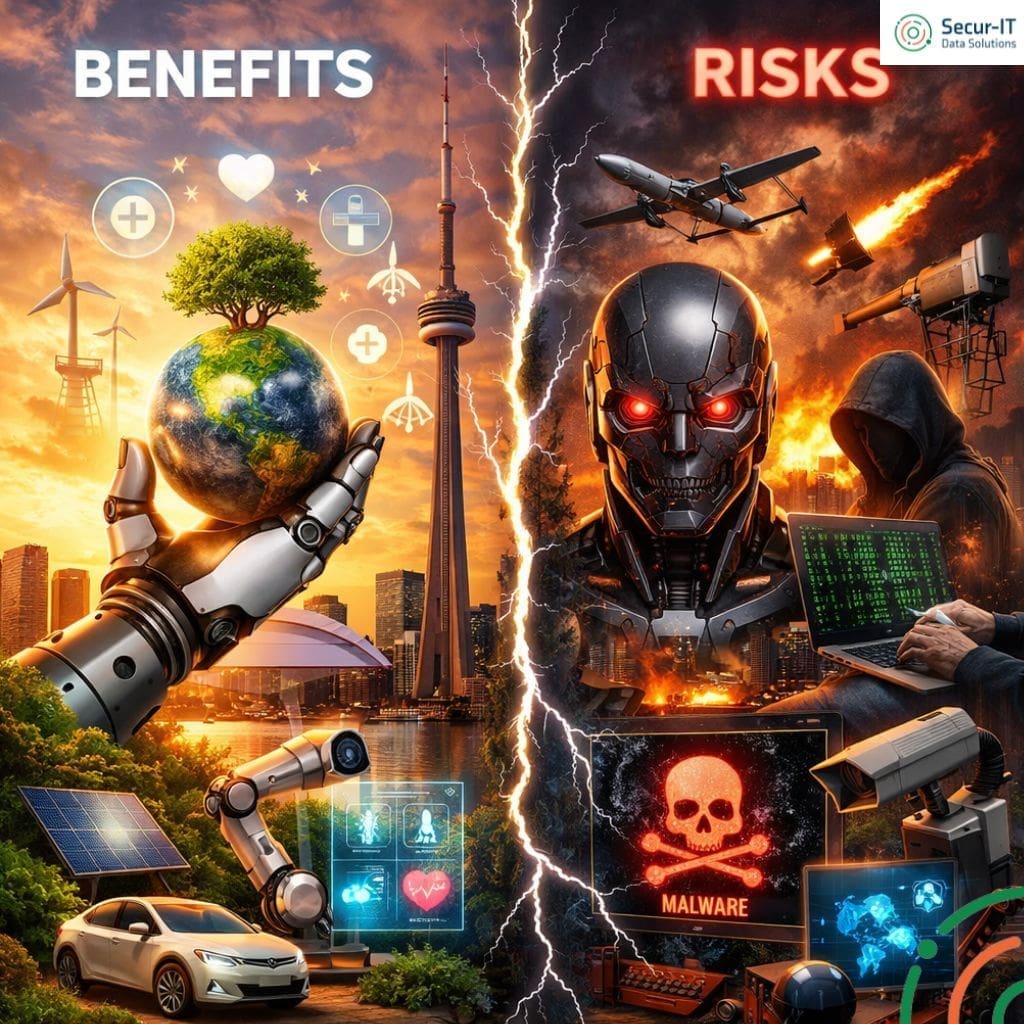
AI risks Canadian businesses face today are unprecedented. AI is now embedded in how small and medium businesses across Toronto, the GTA and Canada work, from Microsoft 365 Copilot to industry-specific SaaS, but it introduces new cybersecurity, privacy and compliance risks that many Canadian organizations are not prepared to manage. Smaller companies benefit the most from AI productivity gains yet often have the least resources, skills and governance to deploy it safely, putting sensitive customer and business data at real risk.
Why AI is different from traditional IT risk
AI tools can learn from your data, which means a single mistake (like pasting PHI or client financial details into a public chatbot) may create long-term exposure rather than a one-time leak.
Generative AI can confidently produce wrong or fabricated information (“hallucinations”), which can mislead staff decisions, clients and regulators if not reviewed by humans.
AI systems depend heavily on data quality and governance; bias, incomplete data or shadow AI tools can create legal and reputational risk even when your core infrastructure appears secure.
This is why AI security cannot just be “one more checkbox” under traditional endpoint or network security; it requires dedicated governance, policies and controls aligned to recognized frameworks like the NIST AI Risk Management Framework.
Key AI risks for Canadian small and medium businesses
Shadow AI and data leakage
Employees frequently copy sensitive content into unauthorized AI tools to “get work done faster,” creating shadow AI outside IT and security oversight. This can expose:
Customer records, health information and financial data subject to PHIPA, PIPEDA and sector regulations.
Internal documents such as security procedures, pricing models, and incident reports that can be misused by attackers.
Weak AI access control and identity protection
Many businesses enable AI features in Microsoft 365, CRM or ERP systems without hardening identity, access control and device security first. Compromised cloud identities can give attackers access to AI-powered search, summaries and copilot outputs across SharePoint, Teams and email, accelerating data exfiltration. OAuth-based integrations and “consent fatigue” increase the chance that employees authorize risky third-party AI apps that siphon data from Microsoft 365, Google Workspace and line-of-business systems.
Compliance, privacy and retention challenges
Canadian SMEs face overlapping privacy and sector rules, yet AI deployments often lack clear data-handling and retention practices. There may be no documented rules on what types of PHI, PCI or personally identifiable information staff can send to AI tools. Logs, prompts and AI-generated content may be stored in locations that do not align with your data residency, retention and audit requirements.
Biased or unreliable AI outputs affecting decisions
AI trained on biased or incomplete data can reinforce inequality in hiring, lending, insurance and other decisions, exposing Canadian organizations to legal and ethical risk. Hallucinated or outdated content in AI-generated reports can mislead executives about cybersecurity posture, financial risk or regulatory exposure. Over-reliance on AI for security triage without human oversight can cause missed incidents or false positives that overwhelm your team.
Expanded cyberattack surface
Attackers already use AI for phishing, social engineering and automation, while targeting misconfigured AI agents and poorly secured APIs. AI-generated phishing and voice-cloning make spear-phishing against Canadian executives and finance teams more convincing and harder to detect. Exposed AI endpoints, weak authentication and insufficient monitoring around AI-powered apps give attackers more opportunities to move laterally and steal data.
Practical steps to tackle AI risk (built for Canadian small and medium businesses)
Essential AI security tools and firewalls for Canadian businesses
Protecting AI deployments requires specialized tools beyond traditional cybersecurity. Here are the key technologies Canadian small and medium businesses should implement:
AI Firewalls and Gateways:
Prompt injection firewalls (e.g., Palo Alto Networks AI-Powered NGFW, Cloudflare AI Gateway) – Block malicious prompts, filter sensitive data and monitor AI API calls in real time.
AI security posture management platforms (e.g., HiddenLayer, Calypso AI, Robust Intelligence) – Continuously assess AI model vulnerabilities, data exposure and compliance risks specific to Canadian privacy laws.
Endpoint Detection and Response (EDR/XDR):
Microsoft Defender for Endpoint, CrowdStrike Falcon, SentinelOne – Detect AI-powered attacks, compromised identities and lateral movement in real time across all devices.
Integrate with AI platforms to monitor unusual AI usage patterns and unauthorized API access.
Data Loss Prevention (DLP) and Cloud Security:
Microsoft Purview Data Loss Prevention, Forcepoint DLP, Symantec DLP – Prevent employees from pasting PHI, PCI or confidential data into unauthorized AI tools.
Cloud Access Security Brokers (e.g., Netskope, Zscaler, McAfee MVISION Cloud) – Monitor and control AI SaaS applications, enforce policies and detect shadow AI usage.
Identity and Access Management (IAM):
Microsoft Entra ID (Azure AD), Okta, Duo Security – Enforce multi-factor authentication (MFA), conditional access and least-privilege principles for all AI and cloud services.
Privileged Access Management (e.g., CyberArk, BeyondTrust) – Secure admin accounts that have elevated access to AI platforms and APIs.
Next-Generation Firewalls (NGFW) with AI capabilities:
Fortinet FortiGate, Palo Alto Networks, Cisco Firepower – Use AI-powered threat intelligence to detect and block AI-enhanced attacks including deepfake phishing and automated reconnaissance.
Deploy web application firewalls (WAF) to protect AI APIs and endpoints from injection attacks and unauthorized access.
SIEM and AI-Powered Security Monitoring:
Splunk, Microsoft Sentinel, IBM QRadar – Aggregate logs from AI tools, endpoints and cloud services; use AI/ML to detect anomalous behavior and potential breaches.
Deploy 24/7 Security Operations Center (SOC) monitoring – Many Canadian SMBs partner with managed security service providers (MSSPs) for continuous threat detection and response.
Start with an AI risk assessment and governance policy
Use a lightweight version of the NIST AI Risk Management Framework (Govern, Map, Measure, Manage) tailored for Canadian small and medium businesses. Define roles (business owner, IT, compliance) and create a clear AI acceptable-use policy that covers tools, data types and approval processes. Inventory AI systems in use (Microsoft Copilot, SaaS tools, chatbots) and map what data they touch, then assess business impact if that data is misused or breached.
Control where and how data is sent to AI
Classify sensitive data (customer PHI, financials, intellectual property) and configure data loss prevention (DLP) policies so it cannot be sent to unapproved AI services. Prefer enterprise AI platforms with encryption at rest and in transit, strong access controls and the ability to turn off training on your proprietary data. Configure retention and logging so AI prompts, responses and system actions can be audited for Canadian regulatory or incident-response purposes.
Train staff on safe AI usage
Provide short, scenario-based training for Canadian employees on what they can and cannot paste into AI tools, how to spot AI-generated phishing and how to report suspicious activity quickly. Include clear examples for Toronto healthcare, financial and professional-services scenarios to reinforce PHIPA, PIPEDA and industry obligations.
Keep humans in the loop
AI should support human judgment, not replace it—especially for higher-risk decisions. Require human review for AI-generated content used in contracts, regulatory filings, customer communications and security incident reports. Monitor AI system behavior and performance over time so you can tune prompts, update models and adjust controls as new risks emerge.
How Secur-IT Data Solutions helps Canadian businesses secure AI
Secur-IT Data Solutions is a Toronto-based managed security services provider (MSSP) focused on helping Canadian small and medium businesses adopt AI securely while strengthening overall cybersecurity posture. Here is how Secur-IT can support your AI security journey:
AI-aware security assessment for Canadian SMBs: Review your current Microsoft 365, endpoint security, firewalls, cloud platforms and AI tools against NIST AI RMF-aligned best practices. Identify shadow AI usage, risky integrations and data-exposure paths that traditional vulnerability scans often miss.
Managed security services with AI protections built in: Deliver 24/7 monitoring, detection and response for endpoints, cloud services and identity, including AI-driven attack detection and automated containment. Implement and manage modern EDR/XDR, secure configuration of Microsoft 365, and network security controls tailored for Canadian small and medium businesses.
AI security governance, policies and training: Develop practical AI acceptable-use policies, data-classification standards and DLP rules that work for small IT teams and non-technical staff. Provide ongoing security awareness training focused on safe AI usage, phishing resistance and real-world attacks targeting Canadian organizations.
Compliance-aligned AI security for regulated sectors: Design AI and cybersecurity controls that support PHIPA, PIPEDA and relevant industry requirements for healthcare, financial services and other regulated Canadian industries. Help you document controls, logs and processes so you can demonstrate due diligence to auditors, boards and customers.
By partnering with a dedicated MSSP in Toronto that understands both cybersecurity and AI risk, small and medium businesses can capture AI’s advantages while protecting critical data, systems and reputation.
References
Government of Canada – Guide on the use of generative AI
Government of Canada – SME AI Adoption Blueprint
NIST – AI Risk Management Framework (AI RMF)
Get Cyber Safe – Why you should never give your personal information to AI
CTV News – Businesses put at risk when employees use unauthorized AI tools at work
Toronto Metropolitan University – Building AI Capacity in Canada’s Small Businesses
International AI Safety Report 2025
Dialzara – Top 5 AI Risk Frameworks for SMBs
Microsoft Security / Ignite AI security innovations

Krikor Tengerian is the CEO and founder of Secur-IT Data Solutions, a Toronto-based cybersecurity firm focused on helping Canadian organizations secure their infrastructure and critical systems. With over 25 years of experience across cybersecurity and IT infrastructure, he has supported organizations in hardening networks, protecting critical workloads, and aligning security controls with business and regulatory requirements.
Krikor actively shapes the direction and themes of Secur-IT’s educational content, collaborating with AI tools to structure, refine, and expand articles while providing the real-world context, use cases, and review to keep them accurate and practical for readers. He regularly shares insights on OT security, threat detection, incident response, and Canadian cybersecurity compliance to help industrial and commercial organizations better understand and reduce their cyber risk.